
Revolutionizing Scenario Generation for Autonomous Driving
A new framework aims to automate scenario generation for autonomous driving, enhancing testing efficiency.
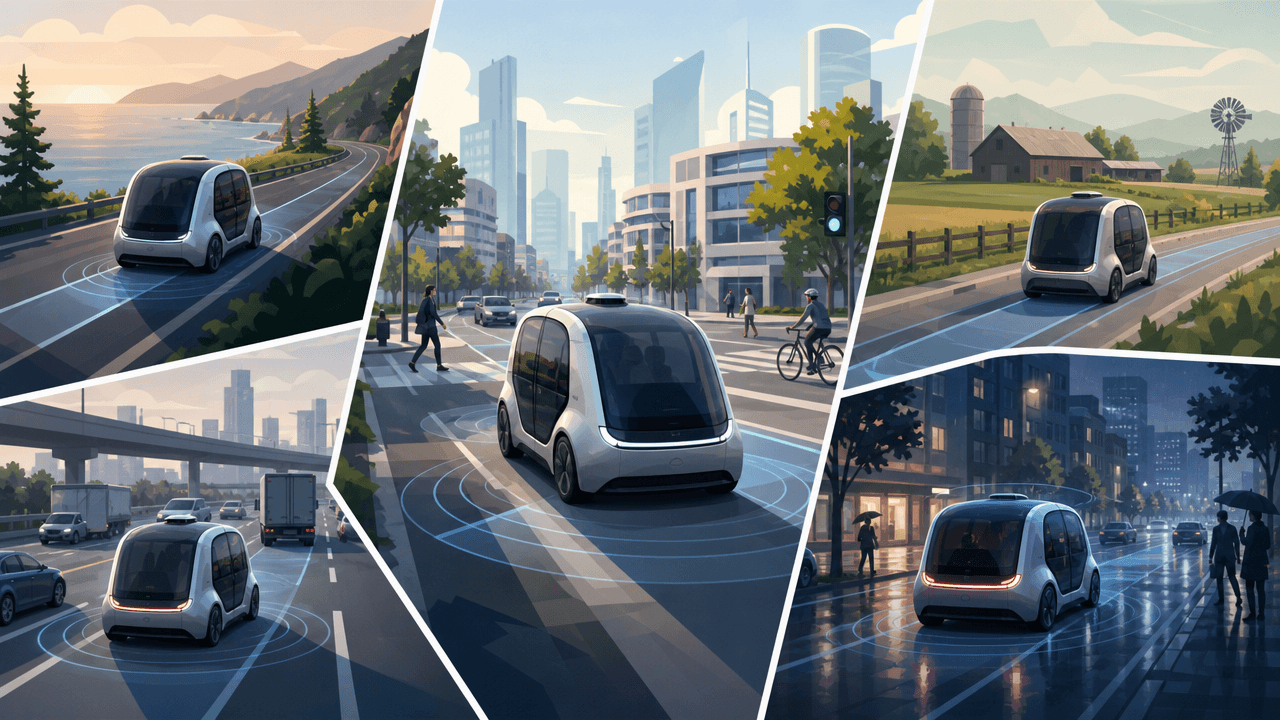
Researchers at the Technical University of Munich have developed Chat2Scenic, a framework that automatically generates test scenarios for autonomous driving systems from regulatory text descriptions. The system addresses a major bottleneck in autonomous vehicle development: creating the thousands of diverse test scenarios needed to validate self-driving systems before deployment.
From Regulations to Executable Tests
Current autonomous vehicle testing relies heavily on manually crafted scenarios, a process that consumes significant engineering time and often produces limited scenario diversity. Chat2Scenic changes this by taking regulatory descriptions - like "maintain safe following distance in highway merging situations" - and automatically generating executable test scripts that can run in driving simulators.
The framework uses a Retrieval-Augmented Generation (RAG) approach, combining large language models with a database of regulatory knowledge. When given a regulation, the system retrieves relevant technical specifications and generates corresponding test scenarios written in the Scenic programming language, which major autonomous driving simulators can execute directly.
The iterative design allows the system to refine scenarios through multiple passes, ensuring they meet both the regulatory requirements and technical constraints of the simulation environment. This eliminates the common problem of generated scenarios that sound plausible but fail when actually executed.
Solving the Scenario Coverage Problem
Autonomous driving companies face a fundamental challenge: they need to test their systems against an enormous range of possible driving situations, from routine highway merging to complex urban intersections with pedestrians and cyclists. Traditional approaches require engineers to manually translate regulatory requirements into test code, creating bottlenecks that can delay vehicle validation by months.
Chat2Scenic generates scenarios that span this diversity automatically. The system can create variations of the same regulatory scenario - different weather conditions, vehicle types, road geometries - without additional human input. Each generated scenario includes the precise parameters needed for simulation: vehicle speeds, positions, timing sequences, and environmental conditions.
The framework also ensures regulation compliance by design. Rather than generating random driving situations, it creates scenarios that specifically test whether autonomous vehicles follow traffic laws and safety regulations. This targeted approach makes testing more efficient and legally relevant.
Impact on Autonomous Vehicle Development
The [arXiv / TUM AVS](https://arxiv.org/abs/2607.14387) research demonstrates successful generation of diverse, executable scenarios across multiple regulatory domains. The framework produced scenarios covering highway driving, urban intersections, and pedestrian interactions, with each scenario running successfully in standard simulation environments.
This automation could compress the timeline for autonomous vehicle validation from years to months. Companies currently employ teams of engineers to write test scenarios manually - a process Chat2Scenic could largely automate. The framework also enables smaller companies to access comprehensive testing capabilities without building large scenario generation teams, potentially accelerating competition in the autonomous driving market.
