
New Framework Enhances Discrete Data Generation with Diffusion Models
A unified framework for discrete denoising diffusion models improves data generation efficiency and quality.
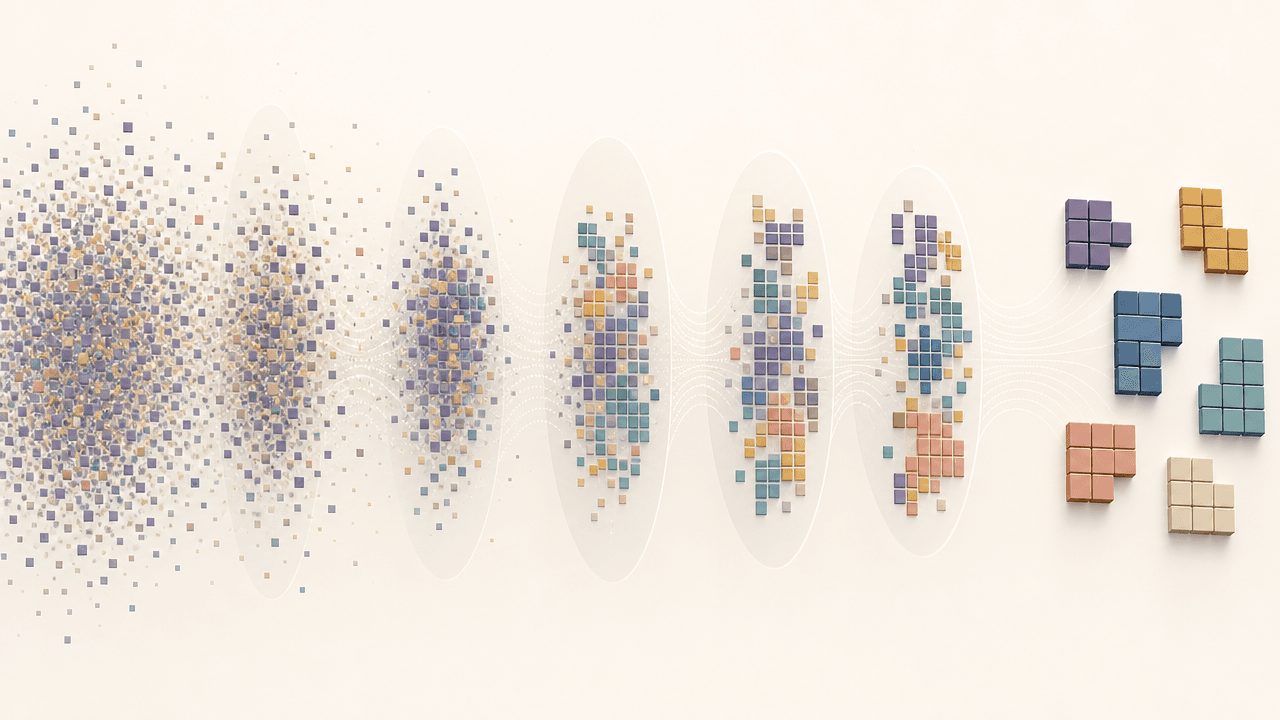
Researchers have developed a new framework for discrete denoising diffusion models (DDMs) that could change how we generate text, code, and other discrete data. The approach offers a compelling alternative to autoregressive models, which generate data one token at a time in sequence.
How Discrete Diffusion Works Differently
Traditional autoregressive models create text by predicting the next word based on previous words. They work sequentially - first word, then second, then third. Discrete diffusion models take a different approach. They start with noise and gradually refine it into coherent output through multiple parallel steps.
The new framework addresses key limitations in existing continuous diffusion models, which work well for images but struggle with discrete data like text or DNA sequences. Unlike continuous data that flows smoothly between values, discrete data jumps between distinct categories - words, characters, or genetic bases.
The researchers developed methods for parallel generation and iterative refinement specifically designed for discrete data. Instead of generating one token at a time, the model can work on multiple positions simultaneously, then refine the entire sequence through several denoising steps.
Technical Advantages Over Current Methods
Current autoregressive models face inherent bottlenecks. They cannot parallelize generation because each token depends on all previous tokens. This creates computational constraints, especially for long sequences.
The discrete diffusion framework removes this sequential dependency. The model can generate and refine multiple tokens simultaneously during each denoising step. This parallel approach potentially reduces generation time for long sequences.
The iterative refinement process also allows the model to reconsider earlier decisions. Autoregressive models commit to each token as they generate it. Diffusion models can revise their entire output multiple times, potentially improving coherence and quality.
Practical Applications and Implications
The framework applies to various discrete data types beyond text. Code generation, molecular design, and DNA sequence modeling all involve discrete tokens that could benefit from parallel generation.
For text generation specifically, the approach could enable new applications where speed matters more than the sequential nature of language. Real-time editing tools, interactive writing assistants, and large-scale content generation systems might benefit from parallel processing capabilities.
The research also opens possibilities for controllable generation. Since diffusion models can modify any part of a sequence during refinement, they might offer better control over specific attributes or constraints in the generated output.
Research Impact
The [arXiv paper](https://arxiv.org/abs/2607.13431) presents both theoretical foundations and practical implementations for discrete diffusion models. The comprehensive framework provides researchers with tools to experiment with alternatives to autoregressive generation.
This advancement could reduce computational costs for generating high-quality discrete data, particularly benefiting companies that rely on large-scale text generation, code synthesis, or molecular modeling. The parallel generation capabilities challenge the dominance of sequential models that have defined natural language processing for years.
